Author: Chia

Talk: Worlding a New Philippines

Reading Time: 13 minutes

I’ve been thinking a lot about what principles and values can be learned from fantasy and the culture of makership/creation that has come as a result of fandom all too often cast aside. From that, I’ve been drawing from personal experiences and observations running Developh to reconsider This talk was delivered under the theme of ‘Innovation and Vision’ for Emerge, a webinar for 450+ collegiate-level student leaders of Alangilan. No recording unfortunately, but here’s the script and slide deck for those who might be interested!

View the slide deck on Figma
View the talk script on Google Docs

Worlding a New Philippines

Worlding A New Philippines – Radical Design for Preferable Futures is a little talk about how I’ve altered my views of leadership through a lens I learned in design, and a bit from fantasy and the unexpected.

What does this title even mean?

  • Worlding (or worldmaking) – The ways which we collectively make the spaces we inhabit through collective practices
  • Preferable futures –– Futures that we positively hope for and work to create based on our hopes, aspirations, and dreams – embodying our notions of what a better world might look like.

First, I want to walk through some of my principles as a technologist that can be told through my work. Another thing is that in any org or community you find yourself in, it’s of vital importance to stick to your principles––if not in presence, in the actions and approach you take things in. I’ll talk about this more shortly.

  • Accessibility at Spotify – how Spotify and similar platforms have changed 
  • Filipino Creatorship –– the significance of cultural context, and how to embrace companies putting localities at the forefront of their work
  • Collaboration and co-creation at Figma –– democratization as a core goal, the potential of viewing everyone as a designer
  • Developh Camp –– introducing artists and technologists to each other’s fields, embracing the importance of intentionality, identity, and making

So what does this deal with?

  • Building a vision towards community building
  • Shedding misconceptions on technology
  • Introducing a framework for org development by worlding

In summary, these can be traced to these three core principles:

  • Culture – heritage, history
  • Community – co-creation, identity
  • Creation – technology, platforms

I also want to give a warning. You’ll have to suspend disbelief a bit for the talk; and this oftens frameworks and processes more than one-off quotes. Like everything you consume, take it with a grain of salt and compare it to the reality you love.

I. Worlding

Worlding in the Realm of Fantasy

  • Think about one of your favorite fictional worlds. 
  • We see most of these worlds as objects as fantasy and obsession; at other times we picture ourselves living in them. We imagine alternate endings for shows and movies that we’re disappointed by, think about the additional depth and richness that we could access if our favorite mangas were turned into worlds. …Or disappointment at it.
  • I know how all of these feel. I find myself entranced by the creation of fantasy worlds. At first, i thought these were just hobbies – things that could stay in stan twitter, until i realized the gravity and depth of what they were actually teaching me.

Here’s my personal case study:

  • One of the things I’ve enjoyed most over the pandemic is Genshin Impact. Yes, the gacha game optimized for mobile (for gamers, that’s a telltale sign of a game being a pay-to-win sellout) that makes use of RNG mechanics to see susceptible teenagers like me anime girls.  More specifically, I’ve been interested in it because of its lore.
  • Here’s the gist of its story. No spoilers here. You play as one of two twin travelers arriving in the world of Teyvat, where seven gods each assigned to an element rule over seven nations. In the beginning, you encounter an Unknown God who seals away your twin; you wake up an unknown amount of time later to search for your sibling––searching across the nations.
  • And in writing, Genshin Impact draws a lot from Gnosticism; concepts such as visionhood that link to allogenehood and ascension pop up. But also Jewish Mysticism, parallels to the Tower of Babel, but also Hermeticism in the roots of power. The Unknown God encountered in the beginning is the god that sustains heavenly principles, or Tianli in Confucianism.
  • And by nature of the seven natures paralleling real-world nations, a lot more specific parallels from Norse mythologies, Shinto, Taoism, to Buddhism recur over and over.
  • The point of me nerding out is to hammer how this made me think a lot about how religion and institutions work. Trade-offs and ethics, the world being morally gray. Essentially, a lot of the same questions in our world posed in unreality and fiction.
  • I was so engrossed in the cultures and myths this game drew from that I even started working on archive its work through the Khaenri’ah Lore Project (http://khaenriah.com).

But ‘worlding’ doesn’t necessarily have to exist in completely fictional systems, it can exist in systems like ours that draw extensively from unreality. 

Let’s take a step back from fantasy first. What even is the point of this, you might ask––I exist to solve real problems.

On solving ‘real problems’

  • First, you may be wondering why I’m even talking about Genshin Impact. You are a fantastic set of student leaders (every one, even if you consider yourselves followers) who have went through a pandemic––maybe some of you #relate to the Genshin stuff, but others might even be shocked at the notion of having enough time to consider games or fantasy when the real world is ablaze. This isn’t wrong, and is a view I would share, too.
  • But there’s things we can learn from fantasy. See: a lot of work and discussions revolve around ‘real problems’ and what’s occurring in the ‘real world’. What’s happening in practice rather than theory, what is happening on the ground rather than in the bubbles of social media. 
  • We have this deep obsession with what is happening in the ‘real world’––but what if fantasy can teach us things?
    • I named countless lessons about culture, history, languages, and mythologies that Genshin Impact has taught me––it’s made me grapple with the concept of power in the form of gods, and helped me meet people all over the world. Fiction is a transformative force. 
    • When we believe in something at odds with the worlds around us, it’s so easy to dismiss it and say that the lessons that can be undertaken would never happen here. As a result, we end up dismissing the lessons and values of what it can teach us when there are so many complex systems that can from it.
  • See, we all know that we are meant to solve real problems. Doing thesis papers, you spend a meticulous amount of time reviewing related literature and building upon a former body of work when you might be eager to just jump in and start working on your thing. 
    • I don’t blame you for when this happens, because we work under unimaginable constraints. It’s unrealistic to do complex, intensive research papers when we can’t even get enough survey respondents for the bare minimum of quantitative data –– and in spaces with lack of resources that seemingly have people work to learn process for the sake of process, this will occur.
    • So you have constraints like money, time, groupmates na di naman nagrereply, lack of advisory resources or ones that aren’t suited for you––or maybe you aren’t even in a course you’re truly passionate about and thus don’t do a deepdive.
  • So many careers are hellbent on this drive to “solve the right problem” that I’m not sure if it’s even possible. Maybe you’ve also faced this similar crisis––am I even going to get into something that’s impacting other people’s lives? It’s easy if you’re a doctor

    My role as a designer is to observe people really well so I can build the right solutions, and do this under the constraints of business and product. We elect politicians democratically so they can represent us, yet are still struggling to have them actually enact legislation and perform actions that serve us. Of course there are ways to solve this; something that students and youth are keen on are finding people who can represent their identities and upbringings––and in this, we hope that they’re better able to stand in for us. 
  • So let’s remove the approach. There is no instant approach or way to resolve the deep-rooted injustices in the country; but we can do another thing.
    • Remember how I mentioned the constraints that we might face as students––such as time, money, experience? Let this approach try and persuade us to move another constraint off the table.

On considering unreality

Two of my favorite design theorists and speculators, Anthony Dunne and Fiona Raby, wrote an incredible essay called ‘Design for the Unreal World’ that had influenced a lot of my perspective on design. 

The crux of the essay is this:

  • We can’t be obsessed with reality. 
  • People and designers often divide the world into a very binary view. There are things, objects, and thoughts that are “real” and those that are “not real”.
  • The truth is, this is terrible for our imagination and for uncovering alternatives to the way things are now.
  • Oftentimes, the word ‘unrealistic’ means ‘undesirable’ to those in charge. Whatever is thinkable is possible.

What really stuck to me was the notion of ‘unrealistic’ often meaning ‘undesirable’ to those in power. When I was growing Developh as a community, one of the most common criticisms we received was that we were too ambitious. I want to dive into an example of why only amplifying the existing status quo is such an isolating, if not damaging and disastrous thing.

But before I talk about a community familiar to me, let’s consider a giant.

Case study: Facebook

Facebook’s aim is to connect people. Intrinsically, this means that their key metrics revolve signing up as many people as possible for their services. Like many corporations with a “corporate social responsibility” angle, Facebook also has a social impact division––a place where I almost interned until I withdrew my offer of acceptance for reasons I can elaborate on another time –– but also, might make clear to you when I articulate this anecdote.

  • People’s understanding of the internet was so warped by Facebook, many citizens believed that Facebook itself was the entire internet. Others believe that Facebook was the internet––little exposure to the world outside.
    • Does this sound familiar?
    • While this likely doesn’t apply to many of you, after all, you’ve found your way on Zoom, this is reality for hundreds of thousands of Filipinos. Arguments and truth exist in comment sections and posts out of context––images without further citations, lost to compression.
  • The main takeaway of it is this:
    We cannot trust solely on the elite and on people of power to develop the world we want to live in. We cannot trust them to shape our communities, platforms, and spaces. We cannot let anyone but ourselves shape the world we want to live in.
  • The thing about Facebook was that it was shaped by people of incredible power. The world’s billionaires.
  • It’s undeniable how negative of an impact it’s had on our nation. 

So what does it mean to design new realities? 

Case study: Developh

  • If there are any student leaders with backgrounds in technology here, you are obviously fascinated by the technologists like Mark Zuckerberg, Bill Gates, Francis Plaza of Paymongo, the leaders at companies like Globe and Smart. Not just limited to technology, really––startups are seeking talent from students in innumerable backgrounds––another alternative to working at multinationals.
  • I founded Develop, a community nonprofit, among this same wonder at technology. At first, it started as an organization that brought friends together to teach one another. If one knew designa and the other coding, we would do an exchange. We’d eventually get on to building things together. There were very few spaces that advocated for this type of peer exchange and depth at the high school level, especially in schools with little exposure to the technology industry in general.
    • I was told that Computer Science was ‘computer sayang’… that the field had little potential, and to go into more traditionally successful things like engineering or to just take up bio.
  • But what were the narratives I was looking up to? Mark Zuckerberg in a dorm room. At Harvard. With infinite resources and a vision that can be destructive.
  • Now, we’re inspired by radical community systems that we discovered from systems in other nations and spaces in the Philippines that were previously rarely, if ever, applied to technology.
    • Community bookstores and pantries: The concept of ‘taking what you need’ and giving back to those who are able. This is not that radical of a move honestly, it’s built on a precedence of trust –– and believing that humans are inherently good, it’s not hard of a move to make. Since encouraging students of any background to give back and teach one day, either in the form of writing or through a traditional talk, we’ve had a huge uptick in events – more than we’ve ever. Through setting something as simple up as a Google Form encouraging people to reach out if they’re interested in mentoring or giving talks, students flooded in –– as long as they saw other students who were taking on similar tasks like them.
      • These community practices seem outrageous to others––how dare something operate on the basis of goodness and selflessness? When in truth, it’s ingrained within us, in our culture. 
      • It’s a palpable sign that people feel threatened by humanity banding together to weather through.
    • An approach to technology driven by that of humanities rather than that of technology. This is something we’re honestly still unsure about. We’re a technical organization driven by advertising ourselves to non-technologists. We keep speaking of the importance of the arts, culture, language, etc. in showing our organization’s potentialities and futures––and this is honestly difficult.

      It’s not the most attractive to investors, it’s often alienating. It’s not even a completely new approach, but it’s something we’re trying to work into the Philippine cultural context.
      • Technology, marketed by money––what if we tell people to create art with it instead? That non-technologists should learn how to program and write scripts to automate their work? That everyone in actuality is already a programmer as long as you apply logic in real life––which happens in actions as simple as getting up in the morning, brushing your teeth, or cooking eggs?
      • In a nation where people so desperately want to break free, we play remarkably too safe at times. Safety only maintains the status quo. Along the same principles is the quote that silence means complacency––and there’s nothing but truth in it. 
      • It’s hard to convince people of a vision. But never lose grip of it.
  • I don’t want to talk too much about what Developh is, but this is a single example that I hope you can carry over.

II. On Systems

So, to everyone here, how can we design the systems that form worlds? How should we even consider the lessons from fantasy and worldmaking in practice?

As a designer, I work with this core question:

  • Realities are constructed rather than given. Can they also be designed?

I think this interestingly happens so richly in a lot of organizations I see. I graduated from a high school where everyone went to school locally, so I’m an anomally, but I often live vicariously through their DP blasts and programming and imagine what my life would be like if I was still back home. Here are examples of realities being constructed. 

Many of you are already applying worldmaking to your practice but may not even realize it.

Here are some examples that you may already be applying:

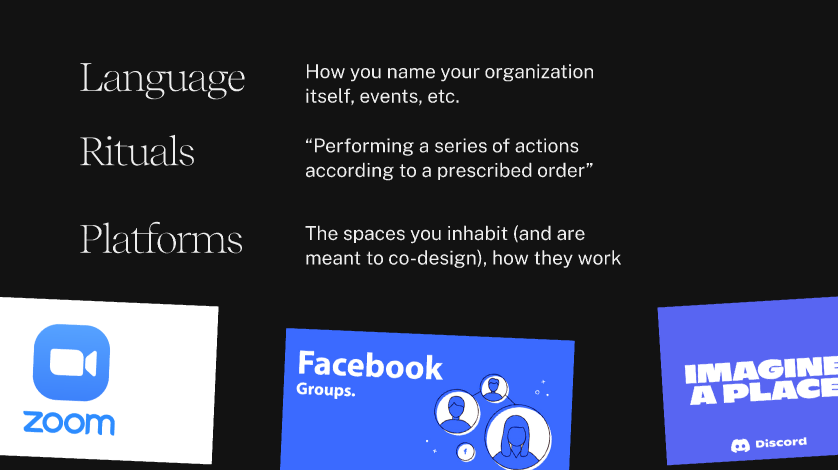
  • Language used to describe membership, events, etc.: This seemingly small thing is ridiculously important –– it’s language, it makes people feel connected. This especially happens if you have org-specific acronyms or words that seem a bit strange and surreal until someone becomes part of an “inner” group. There’s magic in that feeling of belonging.
  • Rituals: If there are certain songs, events, practices, or structures that are continuously incorporated across your organization’s meetings –– you are crafting rituals. More specifically, rituals are loosely defined as a “performing a series of actions according to a prescribed order”; they don’t have to be static and ancient, this is bad, but whenever you enact and document methods and practices that other students after you can follow––you are crafting rituals.
  • The platforms you host your organizations on: A simple example is if your school has an org platform (mine has a custom one, but it’s not very good), versus communicating updates on Facebook groups, email, texts, maybe you’ve even moved to Discord. Platforms and technologies shape the structures and mental models (meaning the internal explanation of someone’s thought process about how something works) you and the people in your community face.
    • A simple example is this: the recent trend (at least, I only saw it popularized in the last year) of sharing Facebook posts with repeated captions and incrementing the number of times it has been said before. Sorry that this is kind of a cringe example, but I hope you get the gist of it.
    • And a broader example is how Zoom was popularized because of the pandemic and spun a lot of memes and jokes. My friend’s class was the ‘get that thirty bro’ class –– and there are lots of traits about the video that are unique to Zoom.
    • These behaviors cascade; the actions your leaders take on, especially, influence what is considered standard and normal. 
  • Themed promotions and marketing blasts: When organizing and constructing promotional scenarios, we already think about alternate worlds. Sure, it’s usually something like ‘generic’ or ‘vintage polaroids’; but when we begin to manipulate languages, construct themed events, etc. –– you are creating history and perspectives to view
  • Recruitment, initiation: I think this is the most obvious org practice where structure and ritual apply where everything I’ve said previously is captured and can happen here. From the way you advertise yourselves to people, the language you use, the designs you create, the rituals you do to induct people to your organization, help them know histories, and empower them to craft the present––you enable something beautiful.

So, my answer to you is that yes – they can be designed, and you’re designing them at every moment. The way you inhabit and occupy space, the way you pass it on and let others stand with you, the way you design the spaces that others join you in.

There are just some things to remember that I feel may already be givens, but are nice to look back to:

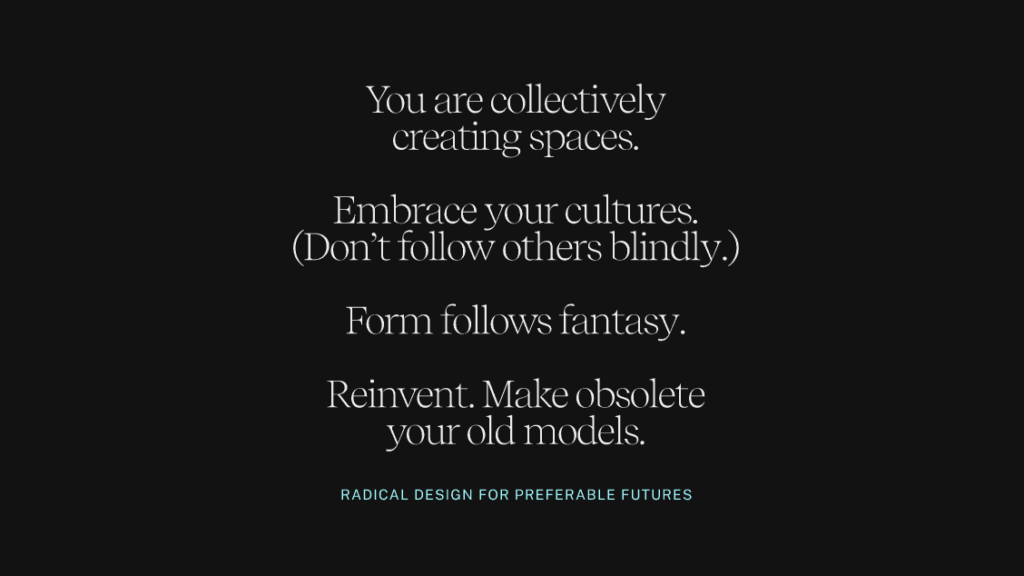
  • You are collectively creating spaces. You as a leader are responsible for the ripple effect and environments that people in your spaces create––you are not the sole inventor of rituals and practice. You are not meant to be an idol or hero; worlds are shaped because of the richness of environments, systems, and histories––worlds are not created by a single person unto themselves; it is a byproduct of what you allow others to bring into you. The worlds you create as a result are richer. This is what i mean by co-creation.
  • Embrace culture. It’s easy to be fascinated at western signals of merit and organizing; to look at news articles of foreigners finding success and wanting to replicate in your own space––but in melting pots and any community worth inhabiting, cultural diversity and richness of experience are what makes it. You are collectively creating spaces, remember? Hear out what the people are you need as opposed to looking outwards––the truest, most meaningful developments will come from your own upbringing because you understand it.
  • This is not mine, but I love it. From Collins: Form follows fantasy. Every good idea comes from a spark of imagination, not pragmatism. Facts are important, but possibility creates futures. Listen to fiction, listen to unimagined needs, get the people around you to voice their hopes and dreams. The most powerful thing you can do is letting the abstract come real; not just manipulating what’s around you.
  • To build the grandest of institutions, you must first build the world around it. Build something that makes obsolete the old, poorer model. Reimagine the world, rituals. Reinvent yourself everyday. This is the rich thing about human experience; because most of this comes from imagination and not physicality––so there is nothing constraining you.

Listen to these things and shape the future. Create people who create with you. Co-authors of a story, leaders just like you. Stand amongst each other. And enjoy a little Genshin Impact when you can.

References, Influences

Also see a similar talk I gave at UX+ 2021, Design is Fantasy

Pondering domesticity

Reading Time: 7 minutes

I remember how much I dreaded the idea of settling down when I was a teenager. It meant to resign oneself to gated communities in Manila, hour-long drives to take your children to Catholic school, and empty pleasantries at Sunday mass for the rest of your life. In my raw, unexposed head –– there was nothing more foreign and undesirable. Nothing farther from passion. The imagery of man and wife strolling across malls rioted in my mind. My sister passing me off in a sweltering church, sweat and little gore past decades-old lace. Settling down in terms of Catholic womanhood meant to forego all of one’s love and potentialities to entirely devote yourself to another. (Do I not do this today, or at the very least seek to?)

In the age where half your friends don’t know how to drive and the other half are falling madly, deeply in love. So deeply that they begin considering human permanence. One friend concusses and sees god, another one swears that they found Him in themselves after someone had shown it to them. (I’ve seen it all along––but I suppose seeing one thing and convincing another that the thing was in them the whole time is a far larger issue.) My love becomes my child. My love becomes the way I love my friends, how much laughter I bring in them. Love here is futile and fleeting; there is only so much that I can project. People find other forms of love. People find new things comparable to love everyday, without idea of how to call it.

A lot of my notions of domesticity revolve around the presence of a physical space. In Manila, anytime not spent in school or the mall would be one at home. My house was where I walked for the first time, where I said ‘I love you’ (yes––over the phone, as what happens in incredibly repressive home life), where I heard the best and worst news of my life. Most of the times, I forget how lucky I was to live in a relatively large home in some suburban place in southern Manila. It had no yards and at 4AM every weekday, we would trek to the inside from our pebbled garage, stained yellow and black from grime and running water flooding in from the back kitchen. I probably stepped on the sparse patches of grass in front of our house no more than a handful of times, and walked through our front gate less. All the front of our home was to us was a place of passing. There were was no waving or lingering there as one would, no porches or delight; in fact, it was beneficial to, as much as possible, act like there was nobody in the house for fear of invasions––or fear of having to leave the front lights one.
The more I think about it, the more I realize how little I know about my house beyond the room I grew up in. I could count the amount of times I stepped on the sparse patches of grass at the front of our house on my fingers, or ever walked through the main doorway. I rarely embraced the narrow walkways that made the edges of our houses connect with neighbor to neighbor (where at their narrowest point, you would have to squeeze your body sideways) the rusting mounds on each of their gate’s carapace, telling not only of security in the physical sense but the emotional. Here, after more than a decade of living, we entrust these secret passage with the katulongs of the other house. They know and can trace every footstep along it more vicariously than anything else. At one opoint, I believed several had a conflicting memoir for me as I slept: the subjected human, the impaling and the testament delivered at the moment of death,

Most of my relationship to family has then been lived in through cars and passing places. The three hour car rides it would take to get to school and back, the other three hours it takes to drive up to Tondo as I memorize the streets and avenues from the back by the way they blur in my periphery, feeling familiarity with the bumps on the pavement and sharp turns south to Cavite. When I went to Yale and spent, for the first time, more than a week without really stepping foot in any vehicle––I realized how much of domesticity has been resigned to false notions of distance. When I stepped into a car (really the first vehicle, no bus, train, or anything else) for the first time after months, I almost physically winced at the strangeness of leather and metal against skin again. The air freshener stung and with my mind like a child’s once again, we went on the highway and I imagined myself jumping outwards––racing across the objects in the window as I would whisk myself over telephone poles and squatter homes.

With friends, I dream of simple things. I’m not sure if we abhor domesticity because the house is an impossible image more than some sacred one. The idea of convention to burn a body, the promise of holding our hands in places that both the sun can reach and where god will consider forgiving us. An apartment in Makati where we can walk to both the grocery and the schools. A garage or no need for one. A dream of living in the same twenty-mile vicinity without taking three hours to get to one another. We overlook the Manila Bay where the water no longer bubbles black, and may even dare to drink water from the tap instead of getting weekly deliveries of plastic gallon barrels that we use to measure. I no longer taste iron or smoke when I lick my lips. I wake up to a sweltering sun and allow myself to be taken by it.
We place ourselves in western fantasy, too. Cottagecore life with the girls where we move into rural nowhere and tend to flowers and become our true selves. Commune in the middle of a European country where we can even begin to consider a lifestyle that does not revolve around our work. Sometimes I’m not sure at which point these desires tread more into the unreal, and which ones are just shuttered down by capitalist dreams.

In this narrative, we resign ourselves to the tenderness and care of one another. The fantasy might make itself as much because there is no where else where we can easily imagine ourselves as safe; the seeming absurdity of a blood bond reinforced and as concrete as little else. No man or being but us.

We’re compelled by little things like the friend hang where we loiter around grocery aisles and spend hours finding flour, stand in line for hours outside the Department of Foreign Affairs with bottles of water, paying bills and finding each other.

Proximities might easily be mistaken as care, though it also feels like the latter can only ever thrive with the former. (Again, I dream of bringing everyone I love in the same place.) With my friends, I’ve developed this newfound urgency to know and be in their presence always (whatever possible, physical distance aside) after what feels like a lifetime of recklessness and suffering. In my childhood home, I wandered around my room over and over and circled a place that still has always felt so alienating. (The summer after I returned from college for the first time, I looked at the ‘now-childhood’ bedroom and barely saw remnants of myself, bare physical artifacts and unrepaired wear and lights the most glorious signs that something had happened, something had been.)
I haven’t been home (‘Philippines’) in three years. I see glimpses of the family in photos, everyone with hair graying out and changing. My father no longer offers to carry my bags up into the car––I do it myself. I turn the lights off myself, no questions asked. I wonder how they feel when they look back into the body of a baby they once nestled, the whole of my life present in front of them and an end they’re not likely to see. I see everyone walking in slow motion, unbearably so, as my own clock feels itself speeding a million miles an hour to a life I was never prepared the consequences for.
I feel compelled to just rush in once again, like I did before I was the child who stopped talking. I bring back rooms into raucorous laughter at the expense of my own self. I perform, and everyone gathers. Everyone is so alive.

There appears to be an unknowable final time for all things. The last time we all convene together for drinks, the last time I sit in the kids table (if ever), the last time we find ourselves in the same Sunday mass. I wonder how many ‘final times’ I have reached with my loved ones there. At least I know the spaces that had contained it.

I like these compressed spaces and the apartment dream. I don’t need to see the world. (What I’m telling myself now, at least.) I can experience it through these brief glimpses of enchantment… in the slo I need to see the people I love tending to their morning coffees and their wounds, I need to desecrate every inch of a box and make my being irreversible. Alternatively, I need to make so many memories and links to spaces that some part of me becomes unquestionably tethered. People walk in and say someone had existed. And it becomes the most lasting thing.

Outside of friendship. I become a realist again. Human beings tend to feel that they must be connected to one other only, that only what they produce can ever truly be theirs. I go back and forth between saying I want kids, jokingly saying that bringing kids in to this world is one of the true mortal sins (both to someone who never asked to be born under this climate, and the world as it ends unto itself). I think about the impossibility of spending my life with one other; where I begin clawing to see a world again when the home I dream of can be a space of convention and transference. Come and go. Begin trading little signs of life. Am I in search for a physical location, a temporal state, or a network of relationships––as if any of these can form what I beg slats can give me? A ceiling stained with smoke and laughter. Mythologies themselves manifest and come alive under the roofs of my friends’ mouths; we begin swallowing futures whole and making worlds that cannot be contained.

But who am I to judge the shame that might be held in an experience I’ve yet to feel? I wonder how we measure the rate of change in people: by their losses, their dwellings, all their gains––how nothing but history can be witness to their enormity, and perhaps in our lifetime, roof slats can stand in for that.

And when I picture myself trying to fill the rooms in my life whole, I look forward to hearing stories and taking in fragments of the new lives that people have lived. Is what I dream of now so different than the carnal state of the home? Or is it fatally flawed because we were meant to walk across the earth? Is it impossible to contain the human life in a concrete dwelling and also dream of constancy and persistence? How can I reclaim this world for all of us? Or at the very least, for myself?
Performing myself, seeking love

Reading Time: 8 minutes

Recently, a friend told me that I’m one of those people who are the sum of their interests. Most known for that, at least. A now-dated meme goes something like, “liking X is not a personality trait“, “hating X is not a personality trait“. Liking field recordings, listening to Phoebe Bridgers, not liking the taste of alcohol, not being into crypto––whatever. I see this and spin into a mild (and irrational) existential crisis. What am I but the pieces of the things that have made me?

The first theory attributes this all to a modern need for hyperlegibility and the constant entering-exiting of spaces. Write bullet point things about yourself, turn traumas into fuel for scholarship, compress your identity into the palatable. People contain themselves in a bio and highlighted tweet, in bylines and extended “my friend Y said Z acts like…”. The enormity of human experience and desire compacted. Mel Nguyen presents an abundance of questions on this: When are you really saying the things you want to say? When do you engage with a subject vs. when do you show a subject? When are you over-reliant on proximity to names, institutions, power? …When are you being ‘you’ vs being the ‘image of you’?
I have so little time that I find myself most comfortable positioned relative to the already digestible. Unfortunately, this method is most successful when dictating yourself to things in power, often formed by people of power.

I remember one drastic personality change that happened in my life. Growing up, I was an immensely hyperactive child: I’d scream and cry for the things I wanted, run all over malls, say yes to so many things. I’d sing at birthday parties (even for the distant relatives) and identify with Ashley Tisdale’s Sharpay. And I felt so loved in the classic way. The one where you make acquaintance-friends easily, have worlds worth of gleeming praise for you because you are seen enough to be loved, your parents tell you how you are sunshine. Somewhere past the first few grades when I started going very online, I developed a more conscientious and reserved sense of self, the type mistaken for rudeness and indifference to the world. A lot of this might have been because of the new media that I was exposed to: narratives in mundane parts of Naruto that got me to think about power, conversations on internet forums that helped me say no a bit more in real life, shedding a submissive self that I had initially been born to perfect. Because these early influences weren’t around me, I craved more of it and attached myself to any other people who shared the same interests because it was the clearest sign that they understood what mindset shift I was going through. Suddenly I was described as callous and robotic. If you like this song, I know there’s at least an inkling of you questioning god, too. Specific shows, songs, and books formed subcultures where it was safe to explore bits of yourself in an overly-repressed world––and we know how popular opinion on that turned out.

Even if the things I enjoy are no longer as shunned as they were in cruel, chastising 13-something years of religious school, I haven’t let go from the mindset it harbored. It’s safer to be with people who already love what I love. It’s difficult for me to translate all the languages and lessons cultivated over the years; it is difficult to anchor someone long enough to get them to listen. I am essentially saying that I don’t know if I am worth taking the time to understand.

This is not to say that mainstream media can’t transform. Squid Game and Parasite are some of the most overt pieces of class critique, same with America’s high school required reading lists. I read Nineteen Eighty-Four and it kickstarted this childish period of activism within me back when I was thirteen, but was never pushed into first doing so. I wonder if they fly over people’s heads so frequently / lose their critical power because of the way they’ve been served to the masses. There is potency in self-discovery, in the community and ritual of self-seeking… of being difficult and complex to love––if there even was any simple form of it extant.

The second theory is just that fuck, I have this fear that I am so unlovable on the surface. Without my body of work and influences present, am I even worth knowing? I mean this in the physical sense now. In a world where attention and time are our most finite resources, there is absolutely no reason that one would pick me out and desire to know me. I have this unbearable, irrational fear even if I am surrounded with people who love me and hear me even when I refuse to look at myself for weeks. Maybe this is just a normal thing. I’m tenuous and hypercritical. Some believe we are in no obligation to know everyone, we pick, and pick, and I wonder if I ever will be. Everyone I deeply admire, especially to the point of ruthlessness, I’ve picked apart and felt endeared by because of what they produce and how they do it.

I wrote this piece earlier in the year that went around a bit about professionalism and authenticity inspired by a then-seemingly fun decision to place mangacaps on my personal site, reminiscent of what I used to do when building out Naruto fansites when I was eleven years old or so. What does that even mean? There’s nothing intrinsically authentic about that. You like something. How does it make you? I groan already at anyone who lines their walls with merchandise and no substance, but fall into the same issue. I want to know how it speaks to you and where you have come from––not that I articulate this myself. ‘Authenticity’ isn’t encapsulated in the boring ass designer bio line of “When I’m not on Figma, I enjoy…“––and it can’t be substituted for either in pretentiously trying to display every little fragment of yourself elsewhere––but I do it anyway.

Another part of the theory is that this is all an act of self-preservation. In performance, I choose how to save myself. I look over my obsession with listing out what I consume: it’s primarily for archival and commentary, yes, but there’s also a big aspect of performance. I’m talking about Spotify playlists (what goes on the profile or not), Last.fm, Letterboxd, MyAnimeList. Deciding what to mark as my favorite, as if I don’t know my favorites, maintaining sacred lists and leaving out the most embarrassing things (less often done in today’s time, very few things can’t be defended as some ironic intake, anyway). One fixation after the other, earmarked for one to see. If I don’t write about how I lived, who else will write it for me?

Sometimes I do this inane thing where I go through the first few scrolls of my social profile and judge the highlight reel of me. What would people think of? Does this look good? Does it represent my interests, or am I tweeting too much about one specific thing? Why do I use my blog to decompress all my teenage feelings instead of internalizing and ironing this out elsewhere? How do I curate my presence so I seem irresistible?

I love things, and if I do love them, then perhaps people will love me through them. I might have to become them in the process, but that’s an issue for later.

But do things make me at all? I fall in love with a movie still am the same person; I replay something eight minutes long over a hundred times in the span of four days and there’s nothing new. (Though I definitely overconsume music.) There’s little observable difference, if anything. Encounters with beautiful pieces of writing and sound become as tender and intentional as the way meeting new people leave marks on my life. It changes where I position my hand when I laugh, the way I elaborate on the news (or don’t), how often I pause on my walks to the next destination and sacrifice a bit on the clock to view the textured stippling of cloud in the sky.

Theoretically, the idea of remaking ourselves everyday is infinitely interesting yet impossible to me. There is no reason for me to be as silent as I am the next day; I thrash and thrive on the precarity of being alive to thousands of strangers in the internet and not knowing what to say after hello on the streets. I wonder how much of this is because of my own disgust at how I physically present and am seen, or because there’s no space to retreat in real life, or because I know that the digital sphere has given me sufficient space to curate and explain myself that I instantly feel more at ease with stranger-acquaintances who know me more than people I’ve known for years.
The impossibility comes from wondering if I even know all the selves I could remake myself as. I see the people around me, yes, but nothing among them I want to become. What makes a voice louder, a thought softer? (Maybe these processes and thoughts are part of why I feel a bit obsessive when I finally can find a framework to latch myself onto?)

Something I realized lately was that I minimize a lot of what I do and love, particularly with people not directly around me in that space. That is, my answers to “how has your week been” or “how did the event go” become terribly curt and almost defensive––”it went okay, I’m not that good” before someone has even had the opportunity to be surprised or otherwise. It’s not even the issue of everyone at this university being immensely complex and successful such that enormous exchanges are casual––I just don’t explain how I feel or what I do at all.
This likely comes as a response to years and years of trying to explain what I love to people and them just laughing it off or not taking time to do so when growing up (hence the need to find people with my own interests). I forget that there are people now who do want to listen. I forget that to be heard, I must let myself speak.

Like many other fumbling, theory-driven designers, I’ve been thinking a lot about speculative design. I have been slowly trying to articulate the gratitude I feel for fandom and fantasy, along with what can be gleamed from unreality. To 450 students at 1:30AM, I talked about ‘Worlding a New Philippines‘ through Genshin Impact, fantasy, and joy––what it means when institutions can learn from new worlds, worldmaking, and the dangers of subjecting our realities to be designed by the few elite who do not best understand us.

This approach to ‘authenticity’ involves a lot of reconciliation with seemingly dangerous, unproductive interests like videogames, music twitter, and the like that I feel a lot of younger people need to hear. The approach also of course, focuses entirely on how we process and externalize these fantasy domains unto our worldview and reality. Clearly I’ve been running around in circles. You can read about it here.

I wish I didn’t make it so difficult for people to like me. There’s obviously a potential whataboutism there that goes something like––if I could be my genuine self without performance, then it means that I’m truly at ease with someone. Perhaps what happens between these events can even be considered as love. Performance might be integrated with how we live; maybe I like to scream what I love out, maybe I am the process of consuming and settling. Struggling with explaining how I live and have fallen into the things I have is something I’ll continue working on.

Closing confession: I feel endlessly indebted to anyone who gives me the smallest bit of attention for what I make. I turn my process into letters for the world. I become infatuated in anyone who cares to love what I love, especially if it was discovered through me. I think sharing in the things that make us is love, or the process of loving, or the in between that might be one of the those things so human, yet so close to magic. If realities are constructed rather than given, I wonder how much of our world is reliant on us saying things to one another, or believing easier. A human word becomes truth. A human word becomes reality. A human word swallows itself.

One day, I want to love someone as hardly as I love the things that make me.


What I thought about while writing this

  • https://subpixel.space/entries/the-disbelievers-guide-to-authenticity/
  • https://www.are.na/paige-h/performing-myself
  • https://www.are.na/chia/on-loving-being-loved
  • https://www.rookiemag.com/2013/04/the-quiet-importance-of-angst-y-art/
  • My friends, the people who listen despite it all – thank you